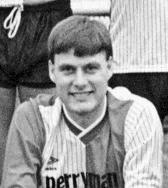
 Mark Graves was a prolific goalscorer in non-league football. He came to Hayes in the summer of 1987 from Wealdstone, where he had been the leading scorer for five successive seasons. Before that he had tried his luck in the Football League, but had
 a return of only three goals in 33 games for Plymouth Argyle over four seasons. At Hayes Mark scored 46 goals in 89+14 appearances over two seasons and remains the last Hayes player to score 20 goals in a league season – in 1987-8 he totalled 23 goals in 37 games. During this season his prolificity was noticed and he was selected for the FA XI against British Police. He joined Chesham United in June 1989.
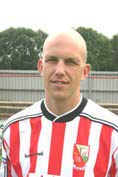
Next comes a more recent player in Matt Gray, a centre-back who joined the Club in 2002 but had his appearances over three seasons severely restricted by a succession of injuries, something that continued with Havant & Waterlooville, his subsequent club. In his time at Hayes, Matt became club captain and made 52+9 appearances scoring 3 goals.
Previously, we came across two Ron  Gadsdens, unrelated, playing at the same time for Hayes. Now we come across two players with the surname Gregory, playing at the same time and in the same position, but, curiously, never in the same match. I still find this observation suspicious and hesitate to be categorical about which one was which. The first of them, J.F. (‘Jim’) Gregory, made his début for Hayes in November 1947 and totalled 14 appearances. He was described as ‘too slow’ when he replaced the other Gregory. He was next recorded playing for Windsor & Eton (and scoring) in an FA Cup tie in 1949-50.
His namesake, J.E. (‘Johnny’) Gregory was the more famous of the pair. Born in 1926 at Hayes, he was recommended to Hayes FC by his commanding officer, when he was stationed at Tenby in Wales, and played for Barry Town, then in the Southern League. He made his début for Hayes on 3 March 1948 and scored against Wealdstone. A week later he married and his place went to…Jim Gregory. When he returned t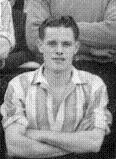 o the side in April it was at the expense of…Jim Gregory. Johnny’s marriage is significant because he and his wife in time became parents of seven children: 5 boys and two girls. And their names all started with the letter J! Two of the boys are significant to our story: John later played for QPR and Portsmouth and was later manager of Aston Villa and Derby County; and Jason played, but without great success, for Reading, Leyton Orient, Hayes and Basingstoke. Anyway, Johnny set the amateur world alight: honours flowed his way. Early recognition by Middlesex and London counties, selections for FA XIs, tours with Middlesex Wanderers, and amateur international trials. In three and a half seasons he made 93 appearances for Hayes and scored 50 goals. It was during his time at Hayes that the club became a powerhouse and was regularly predicted to win the Amateur Cup. With a forward line boasting Eric Lovell, Gregory, Micky Dowse or George Jones, Jack Rawlings and Derek Neate, and an established defence, this was no idle prediction. But the rivalry with Bromley, fellow Athenians, was Hayes’ undoing. Gregory suddenly left and joined the Lilywhites and, when the two clubs were drawn together in the 3rd round of the Amateur Cup un 1951, it was Gregory who scored one of the goals by which Bromley won. But he did not stay long at Bromley and turned professional with West Ham later the same years – amateur international honours were now behind him and his career in the professional game did not prosper. He was transferred to Scunthorpe United, where he stayed until 1957and finished at Aldershot. He went into management with St Neots Town in the Metropolitan League in the 1960s, while working in the ‘Prop Shop’ at Fairey Aviation. He died in October 1995. Perhaps the most accurate description of him came in his son John’s autobiography, when he called him ‘hard’.
The Welsh connection comes with former player and manager Clive Griffiths, who was born in South Wales. Clive had an undistinguished playing career, making 2+1 appearances for Hayes in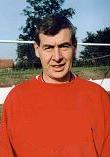 .1969-70, before moving to Ruislip Manor (1970-4), Southall (1974-6), Harefield United (1976-7) and Burnham. He was released by Harefield because of his poor disciplinary record. He was appointed assistant manager by Harry Manoe in 1991 and took over when Manoe resigned in January 1992. For a season the club survived on Manoe’s legacy, but problems started to heap up early in 1992-3, with injuries and suspensions. Despite valiant efforts on his part, the club seemed in disarray and Griffiths was relieved of the managership in November 1993 and replaced by Terry Brown. And the rest is history. Griffiths himself, after a spell scouting for Sheffield United, took over as manager of Chalfont St Peter in March 1994.
Every so often, Hayes has unearthed a player whose early impact was not borne out in the longer term. Chief among these must be Johnny Grondona. In his first game, a Middlesex Charity Cup match at Uxbridge, he scored a hat-trick. Two months later he was off to St Albans. Then he joined Finchley and came back to Hayes in November 1962 in time to pick up his scoring habits before the Big Freeze set in on Boxing Day. By then he had scored eight goals in ten appearances. When football resumed he announced himself ‘unsettled’, and walked out on the eve of Hayes’ Amateur Cup run to the quarter-finals. He joined Maidstone in 1963, replacing David Sadler when he joined Manchester United, Hounslow in 1964, Walton in 1967, Kingstonian in 1972, and Woking in 1974. Already, in 1964, he was described as ‘carrying extra weight’ and, as the years passed, he dropped back to midfield and then defence.
Over the years Hayes has been blessed with competent goalkeepers. One of the best was Dave Groombridge. He made his debut in an FA Cup tie at Hendon which also saw the first appearance of a player who would also make a career in professional football – Joe Stapleton. Taking over from Ron Barham, at a time when goals were scored in profusion, he conceded 27 goals in 22 league games and was instrumental in Hayes’ 3rd place finish. In all he made 37 appearances for Hayes. At the end of the season he turned professional with Leyton Orient. After his playing career was over he coached Leyton in 1962-3, Middlesex Youth in 1964-5, and Edgware Town in 1965-6.
Finally, Les Groves played a couple of games at the end of the 1928-9 season, when he was only 17, but went back to Wealdstone, where his brother R.D. Groves also played. In fact he seemed to vacillate between the two clubs. At Hayes he was known as ‘Sonny’ and at Wealdstone as ‘Navvy’. He came to Hayes for a longer spell from 1932 to 1935 and had success as a goalscoring outside-left. In 81 games he scored 39 goals. Then it was back to Wealdstone again for 1935-6 and, finally, he was playing for Hayes Reserves in 1936-7. He obviously had a special feeling for Hayes, as he wrote to the club in 1945 from the station where he was based at Beauly in Scotland, describing how much football he was able to play in the services.





